 Anyon
Building large "cat states" of light on demand, with feedback instead of luck
Our understanding
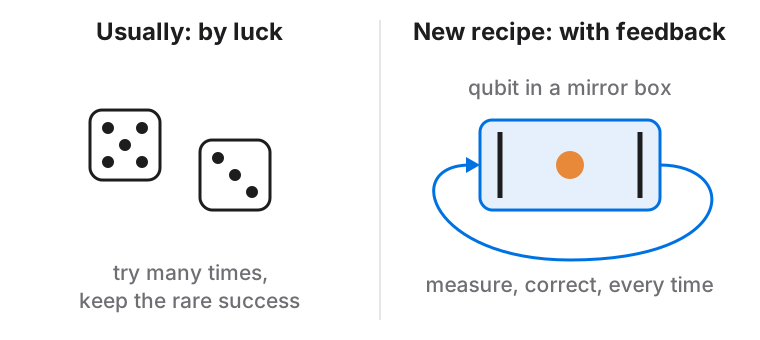
A cat state of light is a light wave that is in two very different states at once, named after Schrödinger's famous cat. Such states are useful for sensing and for protecting quantum information. Today, large ones are mostly made by luck: you try many times and keep the rare success. The authors propose a recipe that works every time. A single qubit in a mirror box shapes the light, and a measurement is fed back to correct it. It is a proposal on paper.
Five of these every Monday, free.
The details
What they did
A superposition of two large, distinct light fields, often called an optical Schrödinger-cat state (our inference: the abstract says "coherent-state superposition"), is a resource for quantum sensing, quantum repeaters and bosonic error-correcting codes, but making large ones usually relies on probabilistic schemes. The authors propose a deterministic protocol: a qubit coupled dispersively to a light mode, as available today in cavity quantum electrodynamics, plus electro-optical feedforward. In their analysis the single-mode protocol beats an advanced three-mode scheme based on Gaussian operations and photon-number-resolving detectors, both in average fidelity and in quantum non-Gaussian features. They also propose the sensitivity of interference fringes to weak displacements as a conclusive witness of quantum interference.
Why it matters
Deterministic sources of large non-Gaussian states are one of the bottlenecks of optical quantum technology; a recipe built from existing cavity-QED ingredients is attractive. This is a theoretical proposal.
What is still open
What fidelities survive realistic cavity loss and detector inefficiency in an experiment? (our inference)