 Anyon
A quantum network link that runs at the speed of a quantum computer
Our understanding
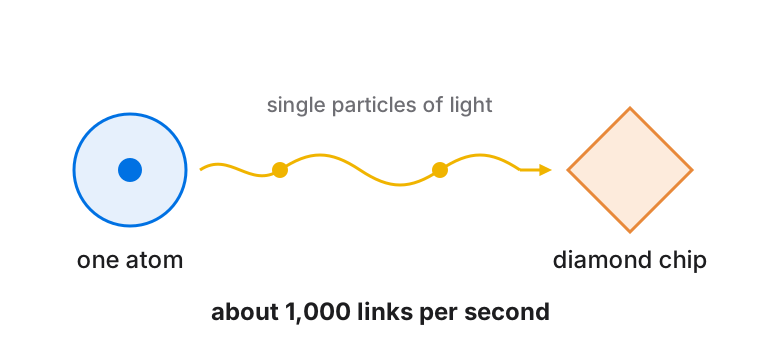
Future quantum computers will probably be built from many smaller modules that have to talk to each other. Here, two very different quantum parts were linked: a single atom held in a trap, and a tiny flaw inside a diamond chip. The atom sends out single particles of light, and each one that arrives confirms a new link between the two. About 1,000 links per second were made, fast enough to keep pace with a quantum computer. The links are 88 % accurate. That is not yet good enough, and the authors list where the errors come from.
Five of these every Monday, free.
The details
What they did
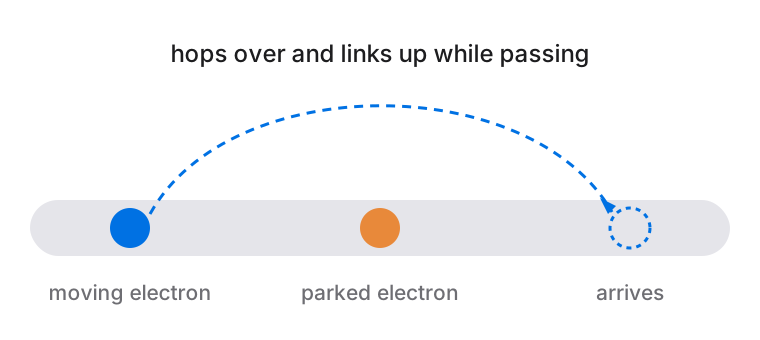
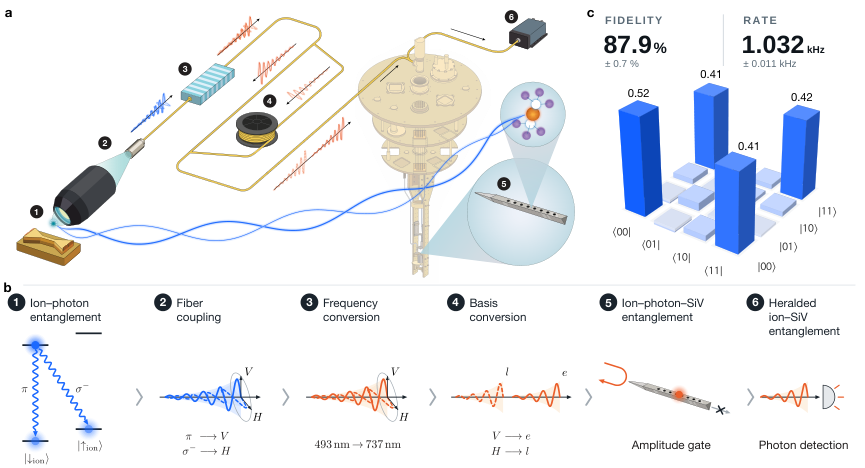
A large quantum computer will probably be built from many modules that have to share entanglement with each other, the way servers in a data centre share a network. The team connected two very different kinds of qubit: a single barium ion held in an electric trap, and a silicon-vacancy colour centre, a defect inside a diamond chip with a built-in nanophotonic cavity, cooled to about 100 millikelvin. The ion emits a photon; the photon's colour (493.5 to 737.45 nm) and encoding are converted so the diamond can accept it; it bounces off the diamond cavity and is detected. Each detected photon announces that the ion and the diamond defect are now entangled. The link produced about 1,030 entangled pairs per second (1.03 kHz) with a fidelity of 87.9 %, from about 1.1 million attempts per second.
Why it matters
One entangled pair per millisecond is comparable to the cycle time of the trapped-ion processors now being planned, so the network link would no longer be the slowest part. It is four times faster than the fastest photonic link between two trapped ions reported so far (250 pairs per second). The trick is to let each platform do what it is good at: the ion is a well-controlled qubit that emits photons at a high rate, and the diamond defect is a quantum memory that interacts with photons almost perfectly inside its cavity. Because the memory reflects the photon, a single detected photon is enough to confirm entanglement, and no two-photon interference is needed.
What is still open
The paper itself gives the target: for continuous error-corrected operations between modules, estimates call for 10 to 100 kHz of entanglement at an error rate about ten times that of local two-qubit gates. This link is at 1 kHz and 12 % infidelity. The authors break the infidelity down by subsystem (ion 4.3 points, frequency conversion 2.9, memory 3.9, lost heralding photons 1.9) and write that none of the dominant errors is fundamental. How far can rate and fidelity be pushed together, given that fewer lost photons would improve both at once? (The last clause is our inference from the paper's rate–fidelity trade-off.)