 Anyon
Conveyor belts for qubits: a blueprint for fast, low-overhead error correction in silicon
Our understanding
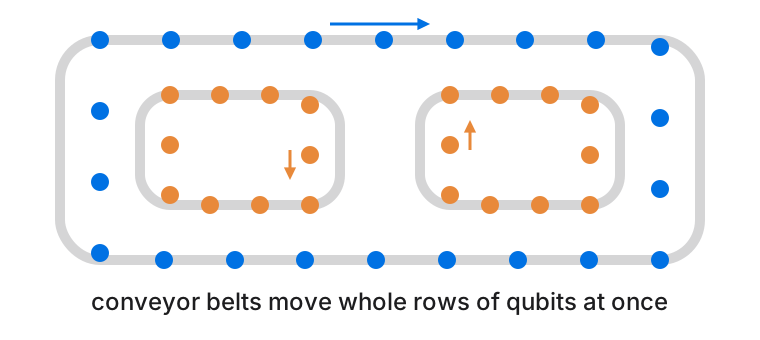
Some of the most efficient ways to protect quantum information need qubits that sit far apart to compare notes. In silicon chips, qubits can be moved quickly, but only along fixed tracks. This design lays the tracks out as conveyor belts inside conveyor belts, so whole rows of qubits move together and meet the right partners. In simulations, one full round of checks takes less than 50 millionths of a second, hundreds to thousands of times faster than with neutral atoms. It is a blueprint. Nothing has been built yet.
Five of these every Monday, free.
The details
What they did
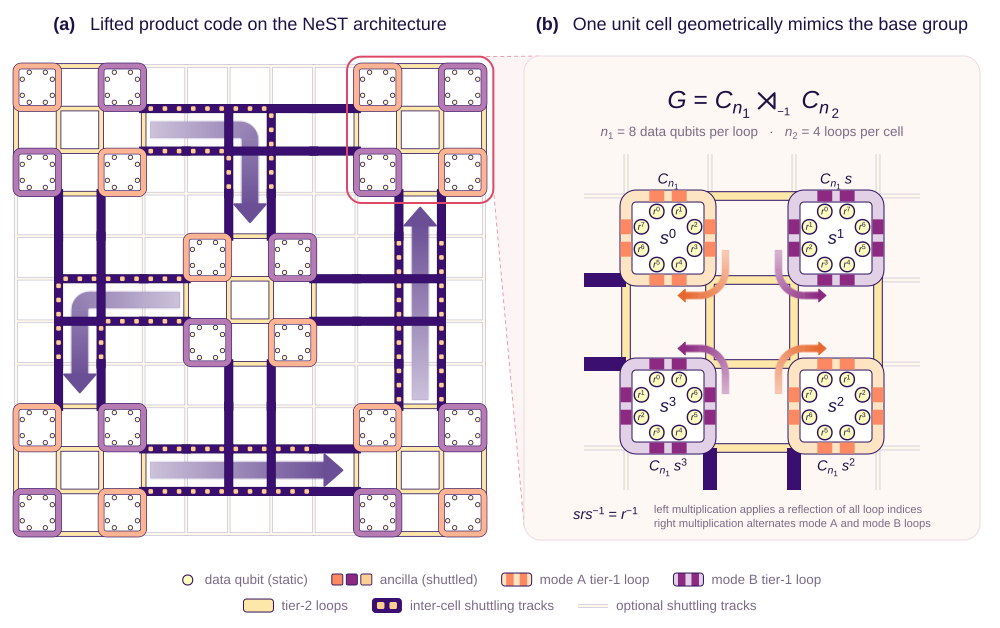
Quantum low-density parity-check (qLDPC) codes can protect many logical qubits with few physical ones, encoding rates up to 50 % at useful distances, but their checks connect qubits that are far apart; so far only neutral-atom machines have supplied that connectivity. The paper proposes doing it with silicon spin qubits, which can be shuttled along fabricated tracks in microseconds rather than milliseconds, but only along fixed paths without collisions. The design, NeST (Nested Shuttling Tracks), arranges nested conveyor-belt loops on a square lattice so that every required permutation becomes a rigid, globally controlled motion of whole trains of qubits. A code search finds rate-20 % codes up to [[1400, 280, ≤ 28]]; circuit-level simulations including shuttling dephasing give thresholds above 10⁻³ with stabiliser cycles under 50 μs, two to three orders of magnitude faster than neutral-atom implementations. For a [[150, 30, 10]] code the author builds a code-surgery gadget with no extra qubits and 29 % more gate layers.
Why it matters
It is the first co-design of a qLDPC code family and spin-qubit hardware, according to the author, and it argues that very low overhead and a fast clock need not be traded against each other. All of this is design and simulation; nothing has been built.
What is still open
The headline logical error estimate (10⁻¹⁴ per qubit per round) assumes a ten-fold improvement over early shuttling demonstrations and other errors at 0.1 %. Which assumption is closer to today's silicon devices, and what happens to the thresholds if shuttling stays where it is? (our inference)